TWO:Walpole, however, continued to oppose the South Sea Bill in the Commons, declaring that the terms were too extravagant ever to be fulfilled; that the experiment could result in nothing but a fearful increase of the costs of stockjobbing, and final confusion and ruin. He insisted that, before the proposals of the Company were accepted,[47] the rise of their stock should be limited, and every means taken to prevent the fever of infatuation that would ensue from the promise of dividends out of funds which could never be realised. He proposed for this purpose the introduction of a clause fixing the number of years' purchase to be granted to the annuitants of the South Sea Company; but to this it was objected that it was the interest of the Company to take up the annuities; and, as the annuitants had the power of coming in or not, as they pleased, the Company would, of course, offer advantageous terms, and, therefore, the whole affair might be safely left to private adjustment. Aislabie added that the South Sea Company would not submit to be controlled in an undertaking they were to pay so dear for. The Bill passed both Houses.To approach Ferdinand's forces, the French were obliged to pass a narrow ground between a river and a marsh, and were so cramped that they committed the very error which cost them the battle of Blenheim. They placed the cavalry in the centre, and made wings of their infantry. The cavalry made a succession of furious charges on Ferdinand's centre, but this stood compact and immovable, till the French horse, being discouraged, the Allies charged in their turn, and the centre of the army, the cavalry, being thus driven back, the whole line gave way. At this moment Ferdinand sent orders to Lord George Sackville to charge with the cavalry, which had been kept in reserve, and thus complete the destruction of the flying French. But Lord George, who had been constantly quarrelling with Ferdinand, as well as his own second in command, the Marquis of Granby, now did not appear to comprehend a succession of orders, and sat still. But Ferdinand, having lost patience, sent word to the Marquis of Granby to advance, and he promptly obeyed, but it was now too late; the French had got half an hour's start. Thus the English cavalry was deprived of all share in the victory; but the English foot had borne the chief brunt of the attack, being in the centre. Six British regiments, in fact, for a time maintained the whole shock of the French. Sackville was tried by court martial, and dismissed from all his military appointments. The battle of Minden was fought on the 1st of August, 1759.
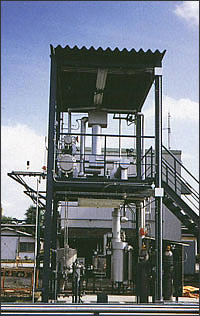
Great attention is recently being paid to global environmental issues, and it is now conceivable that companies will need to treat used solvents themselves. In consideration of this kind of social issue, we have developed a “membrane separation type solvent dehydration system,” which uses a polyimide membrane with superior dehydration properties developed by Ube Industries, Ltd. in combination with our own distillation and concentration technology that has resulted in solvents being more easily recovered.
THREE:
- 1Under the distillation system, even in case of azeotropic solvent compositions, this system which remove water vapor by the polyimide membrane will easily dehydrate.
- 2In comparison with the distillation system, it significantly saves on use of steam.
- 3Dehydration can be performed through merely supplying evaporated vapor to the membrane module and maintaining the differential pressure between the permeable side and the impermeable side.
- 4Solvent purity of 99.9% or more can be achieved by carrying out dehydration with a polyimide membrane only.
- 5The polyimide membrane has superior heat and solvent resistance. Therefore, the vapor permeation system reduces contamination of the membrane and thus extends its life.
THREE:Farmhouses had no new ¡°boarders.¡± The house on the estate, searched with youthful vim and alert thoroughness, revealed no observable hiding places. Sandy finally gave up.
The aromatic polyimide membrane is highly permeable to water vapor but less permeable to vapors of organic compounds such as alcohol etc.
THREE:It was at the close of 1719, when George I. returned from Hanover, that this Company proposed to Ministers to consolidate all the funds into one. It was strange that both Ministers and merchants could be deluded by the hope of enriching themselves by a share of the trade with the Spanish South American provinces, when Spain herself, in full enjoyment of them, was sunk into indigence and weakness, and presented the most determined resistance to the unfettered intercourse of any other nation with them. Yet Sir John Blunt, a leading director of the South Sea Company, persuaded the Ministers that by granting the Company power to deal with the public funds, and especially to buy up the unredeemable annuities which had been granted in the two preceding reigns, chiefly on terms of ninety-nine years, and which now amounted to about eight hundred thousand pounds a year, they could, in twenty-six years, pay off the entire National Debt. But, to enable them to do this, they must be empowered to reduce all the different public securities to one aggregate fund in their hands, to convert both redeemable and unredeemable debts into stock by such arrangements as they could make with the holders, and to have certain commercial privileges vested in them. Ministers accepted the proposals with great alacrity. Aislabie introduced the scheme to Parliament in the month of February, 1720, declaring that, if it was accepted by the House, the prosperity of the nation would be amazingly enhanced, and all its debts liquidated in a very few years. Craggs seconded the proposal in most sanguine terms, expressing his conviction that every member of the House must be ready to adopt so advantageous an offer. Ministers had already closed with the proposals of the Company, and they were themselves greatly disconcerted by the suggestion of Mr. Thomas Brodrick, the member for Stockbridge, who expressed his entire accordance with Ministers, but thought that the nation should endeavour to obtain the best terms for itself by opening the competition to every other company or association of men as well as that in question. Ministers were confounded by this proposal, and Aislabie endeavoured to get out of it by declaring that to do this would be like putting the nation up to auction, and that such things should be done with spirit. But Jekyll interposed, saying it was this spirit which had ruined the nation, and it was now requisite to consider seriously what was best for the public. A violent debate ensued, in which Walpole eloquently recommended open competition, and was sharply replied to by Lechmere. The question was carried in favour of competition; and then the Bank of England, which before had coolly declined to enter into the proposals, suddenly appeared in a new temper, and made liberal offers for the privilege of thus farming the public debts. But the South Sea Company was not to be outdone; it offered seven millions and a half, and the Bank gave way in despair.Jeff explained. He had sent a radiogram to the yacht, and as its owner had already sent one identifying Jeff, he was given the information that the real necklace was being brought back, extra heavily insured in a London company, by the captain himself.
- 1 Recovery of the detergent solvent Recovery of the cleaning solvent such as electronic parts industry, precision instrument industry.
- 2Solvent recovery and the refinement Solvent recovery and the refinement such as chemical industry, an industry of medical supplies, food industry, the fermentation industry.
THREE:The parson expressed pity¡ªand felt it, which is more.Larry had to do a little rapid mental arithmetic.
Acetone, ethanol, methyl ethyl ketone, butanol, isopropyl alcohol, ethyl acetate, methyl isobutyl ketone, others (including hexane and toluene).
